
2026 marks my twentieth year of trawling through Albion’s muddy fields, farting in front of villagers, and accidentally kicking chickens into orbit. I love Albion like a worn-in pair of boots—every cobblestone in Bowerstone Market, every creaking timber in Oakvale, every smog-choked chimney in industrial Bowerstone. But honestly? I’m starting to feel like a goldfish that’s memorized every plastic castle in its bowl. The Fable universe is a beautifully detailed diorama, yet for two decades we’ve mostly been staring at the same figurine under the glass bell jar while whispers of an entire sprawling world floated just out of reach.
Lionhead Studios was a master of the coy behind-the-shoulder glance. They’d scatter breadcrumbs about distant lands—a katana here, a smuggled spice crate there, a random NPC claiming their cousin twice-removed discovered a lost city—but never let us take the ship ourselves. Albion evolved magnificently across the trilogy, shapeshifting like a medieval larva into an industrial butterfly with firearms and factories. Still, every time I’d sail to the edge of the map, I’d find only the same invisible wall and the faint, mocking scent of adventure. With Playground Games now holding the keys to Fable’s kingdom, and with Fable (yes, the ominously unnumbered one) in players’ hands for a couple of years now, those unreachable lands are no longer just footnotes in a dusty codex. They’re lodestars.
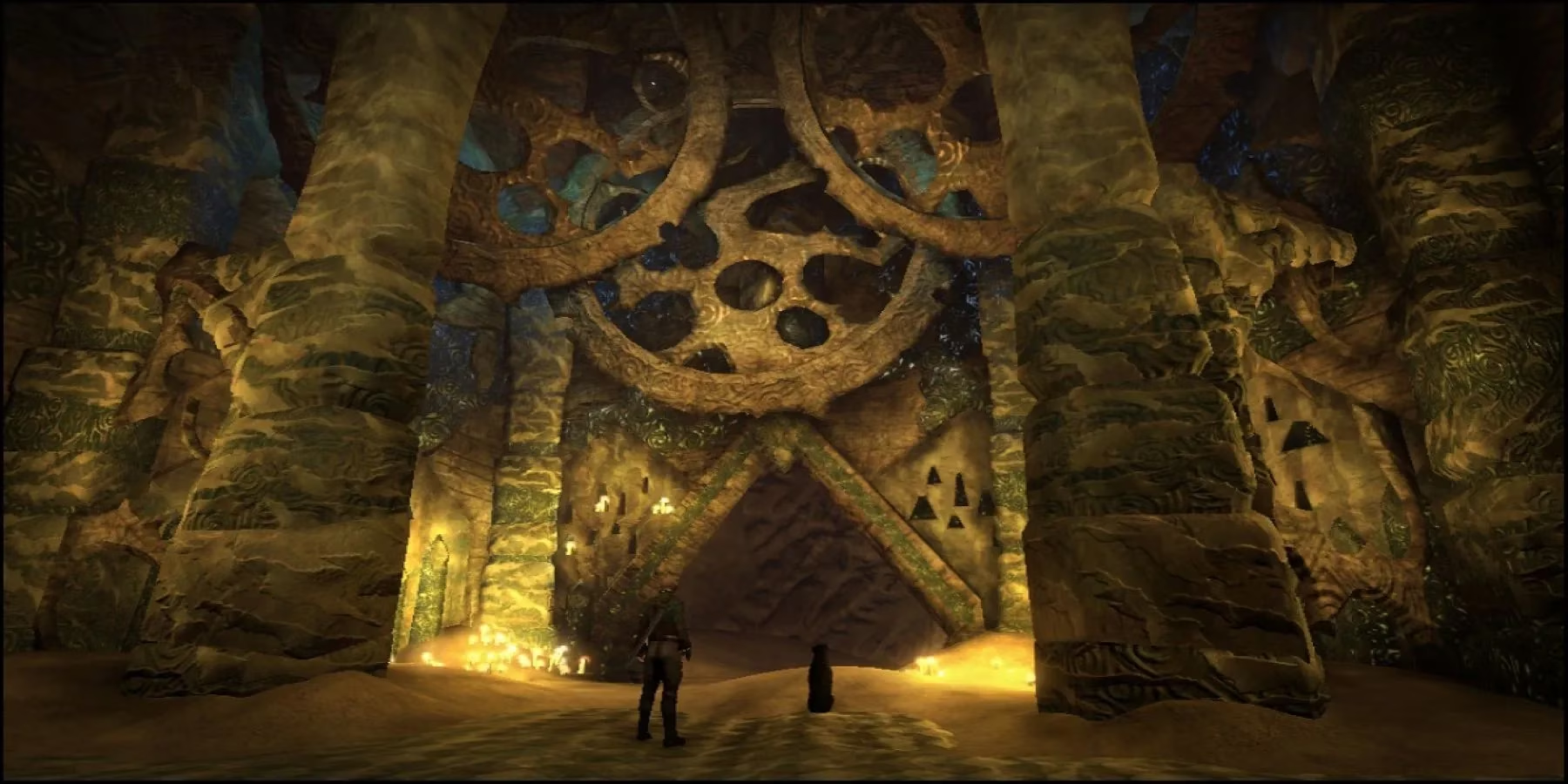
Let’s start with the one we actually got to soil our boots in: Aurora. This southern desert nation, separated from Albion by a temperamental sea, appeared in Fable III like a sudden sandstorm in a library. The Hero of Brightwall sailed over, found the place drowning in Darkness (capital D, very ominous), and beat the literal shadows out of it until it agreed to become an Albion protectorate. The whole episode felt like being handed a single chocolate truffle from a box of fifty and then yanked away from the table. Aurora was a whisper of what could be—a culture with its own architecture, its own costumes, and a terror that had nothing to do with balverines. It also made me realize something: Albion isn’t the sun of this universe; it’s just a particularly loud planet in a very starry galaxy.
Far more famously dangled in front of us is Samarkand, the desert-trading superpower that gave Albion katanas, gunpowder, and presumably a lot of sand in its diplomatic pouches. For years, I’d heard tales of Samarkand as a place of turbaned merchants and spice markets that would make a Hobbit’s pantry look amateurish. The dizzying part? Nobody can agree where it actually is. Some in-game sources suggest it lies west; Theresa, that cryptic oracle who knows more than she ever lets on, insists it’s east. I picture the nation as a metaphysical pin on a cartographer’s fever dream, shifting every time someone draws a new map. Beyond Samarkand, the lore whispers of the Eastern Kingdom, which Theresa visited post-Fable I like some sort of sabbatical to find herself among faraway tea ceremonies. In my headcanon, the Eastern Kingdom is less a place and more a concept—a half-remembered poem that Albion is too uncouth to fully recite.
Then there are the places so obscure they feel like someone’s inside joke that we were never meant to hear. The South Islands, for instance. The Snowspire Oracle mentions this region with all the enthusiasm of a librarian reading a grocery list, yet it’s apparently the birthplace of Thunder and Whisper, two Heroes whose names still echo in Fable’s history. I like to imagine the South Islands as a string of volcanic colonies where warriors are trained by wrestling lava crabs and the national dish is something that bites back. Just as misty are the Cities of the West, which we learn about only because a questgiver named Belle Rennock decides to retire there after her lengthy Archaeologist quest. That’s it—an entire civilization reduced to a retirement plan. It’s as if the game winked at us and said, “Oh, those grand western metropolises? Yeah, Belle likes the golf courses there.”
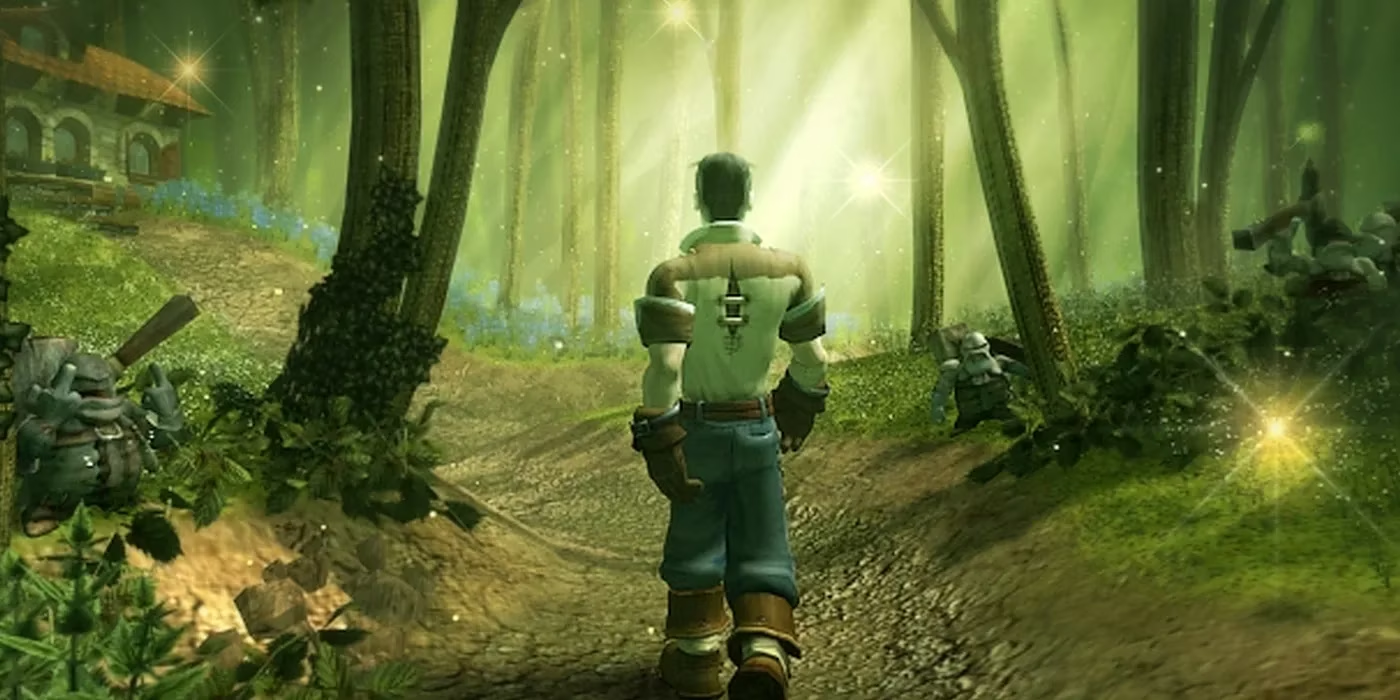
My personal obsession, however, is the Edgelands. This northern scrap of map is like the diary you find in a derelict house—pages torn, ink smeared, but every sentence crammed with ghost stories. Once sparsely populated by people who presumably enjoyed chilly vistas and ancient ruins, the Edgelands were largely abandoned thanks to Reaver Industries’ bumbling in Fable III. They appear in Fable: The Journey as a passage for Gabriel and Theresa, a landscape of crumbling civilizations that served as a connective tissue between fable and fable. I like to think of the Edgelands as the Earth after humans disappeared, but still carrying the echoes of spells and sword clashes. If Playground Games ever wants to gift us a more haunting Fable experience, the Edgelands are right there, waiting like an unlit fireplace in a mansion nobody visits.
With Playground’s Fable having unleashed itself on the world, I can’t help but peek over the horizon. The pre-release trailers kept things coy, showing a fairly traditional Albion—rolling green hills, a castle here and there, the Hero doing their thing. But that might just be the comfort food first course. The real banquet could lie in whatever is beyond those familiar shores. Perhaps we’ll finally get to haggle in a Samarkand bazaar, where you can trade a legendary sword for a crate of explosive-looking fruits. Maybe the Southern Islands will teach Albion what a real storm looks like. Or perhaps the Western Cities will turn out to be steampunk utopias where Belle Rennock has become mayor-for-life. Whatever the case, I’m ready. My boots are polished, my chicken-kicking muscles are toned, and my sense of wonder has been on standby for twenty years. It’s time to stop listening to nursery rhymes about places we’ve never seen and start living them.
This assessment draws from Eurogamer, whose long-running reportage and criticism often emphasizes how beloved franchises stay resonant by expanding their sense of place, not just their feature lists. In that light, the Fable blog’s fixation on “unreachable lands” like Samarkand, the South Islands, and the Edgelands reads as more than lore-geek wishlisting—it’s a clear argument for worldbuilding as payoff: letting players cross the implied borders, encounter new social rules and economies, and discover what Albion looks like when it’s no longer the center of the joke.
Loading comments...