
As I sit here in 2026, reflecting on my time shaping the world of Albion, I can't help but feel a profound sense of melancholy about how the game development landscape has transformed. Peter Molyneux, Dene Carter, Georg Backer, and myself—we were part of a generation that viewed sequels not as guaranteed cash cows, but as opportunities for genuine artistic reinvention. Today, the industry's heartbeat seems to have shifted. The prevailing sentiment, which we discussed at length, is one of heightened risk aversion. Molyneux often asks, with a wistful tone, 'Would Fable 2's bold departures even be greenlit in today's climate?' It's a question that haunts many of us who remember a different era.
The 'Shame' of Sequels and a Fearless Philosophy
Can you imagine a lead developer today openly stating there was a 'shame in doing sequels'? That's exactly the ethos we operated under at Lionhead. We didn't want to just create 'Fable 1.5.' The goal was never 'bigger, better, more.' For us, a sequel was an obligation to challenge ourselves and our players. Dene Carter, our creative director, was adamant about this. He famously drew inspiration from an unlikely source: the British comedy Blackadder. Just as that show leaped through history with each season, we envisioned a Fable sequel that would boldly advance time, fundamentally altering the world players thought they knew. This wasn't about adding more weapons or expanding the map by 20%; it was about changing the soul of the game. Isn't that what true innovation should be?
Embracing Darkness and Defying Test Feedback
One of our most audacious moves was transforming the idyllic, sunny Oakvale from the first game into the grim, bog-ridden Wrathmarsh. We deliberately crafted a darker tone, forcing players to confront the decay of a place they once loved.
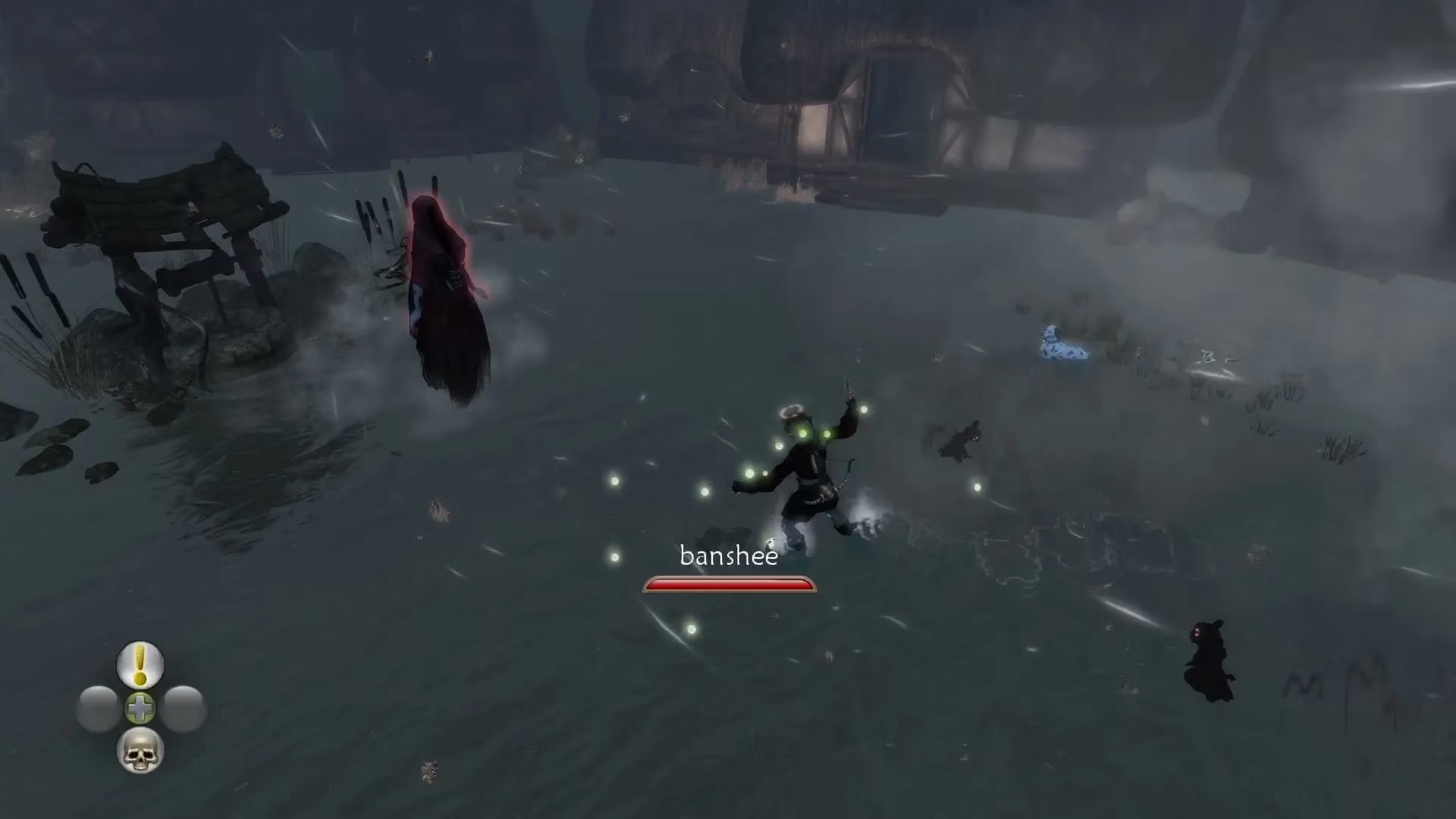
This visual shift symbolized our entire approach. Peter Molyneux recently reminisced, 'We were a bit fearless when it came to stuff like that.' He's right. Today, such a drastic tonal and environmental shift would likely be flagged immediately in focus testing. 'You wouldn't ever do it now because you’d probably get [negative] test feedback on it,' he lamented. The data would scream that players wanted more of the familiar Oakvale, not a corrupted version of it. But we believed in the narrative power of that transformation. We took the big risk. Where has that courage gone in 2026? Has the quest for the perfect metrics sheet sanitized our creative boldness?
Innovation in Storytelling: Dialogue Over Cutscenes
Our philosophy extended to every department. Georg Backer, our dialogue producer, embarked on a monumental task. He wanted to move the story away from lengthy, cinematic cutscenes and weave it into the very fabric of the world. His vision was to have the townsfolk of Albion tell the tale through their gossip, fears, and daily conversations. This was a radical departure from the first game's more traditional approach.
-
The Scale: Backer admits they recorded 'tonnes' of dialogue. The recording sessions were marathons.
-
The Method: He'd often be 'running around and hoping they had gotten through enough lines in a session.'
-
The Goal: To create a living, breathing world where story discovery was organic, not a passive viewing experience.
This was a huge logistical and creative risk. Would players notice? Would they care? We bet they would. It was about respecting the player's intelligence and agency, a principle that feels increasingly negotiated in modern blockbuster design.
The Lionhead Legacy: Where Are We Now?
As we look toward the future of the Fable franchise with its new developers, many of us from the old guard watch with keen interest. For the first time, we might get to experience Albion purely as fans. But our own journeys in the industry have continued, often on paths that reflect the changing times:
| Developer | Role on Fable 2 | Current (2026) Project | Notes on Risk & Innovation |
|---|---|---|---|
| Dene Carter | Creative Director | Running Fluttermind (mobile games) | Explores accessible, iterative design in a different market. |
| Georg Backer | Dialogue Producer | Recently launched Viewfinder (puzzle game) | His new game 'reshapes reality' with a camera—a core, innovative mechanic. |
| Peter Molyneux | Visionary Lead | Controversial Legacy (NFT game) & other projects | Embraces the risky, volatile frontier of web3, for better or worse. |
It's fascinating to see where our paths have led. Backer's Viewfinder is a testament to the kind of singular, mechanic-driven innovation we loved. Carter operates in the agile world of mobile. And Molyneux? He's once again in the eye of the storm, chasing a new, controversial frontier with NFTs and blockchain—a different kind of risk altogether, one fraught with financial and reputational peril. It proves the drive to innovate never leaves you, even if the landscape changes dramatically.
A Final Reflection on Risk in 2026
So, what is the state of creative risk in 2026? The tools are more powerful, the teams are larger, and the budgets are astronomical. Yet, the safety nets have multiplied. The pressure to replicate proven formulas is immense. When we made Fable 2, we asked, 'What would make this a meaningful, surprising journey?' Today, the first question too often seems to be, 'What does the market data say?' I fear we are optimizing the joy out of the process. The 'big risk' we took with Wrathmarsh, the time skip, the dialogue systems—these weren't calculated market plays. They were acts of creative conviction. As the Fable series is reborn, I hope its new stewards find a way to recapture that spirit. Not the specifics of what we did, but the fearlessness behind it. The industry needs it. The players, whether they know it or not, crave it. After all, isn't the magic of games found in the unexpected?
This assessment draws from PEGI, whose classification framework underscores how tonal shifts—like Fable 2’s pivot from Oakvale’s warmth to Wrathmarsh’s bleakness—often intersect with content descriptors around fear, violence, and mature themes, influencing how daring creative reinventions are packaged and communicated to players in a more risk-managed era.
Loading comments...