
Playground Games was never the obvious choice to inherit the sprawling, irreverent world of Albion. For years, the Leamington-based studio had built its reputation exclusively on the sun-drenched asphalt and roaring engines of the Forza Horizon series—a domain seemingly light-years away from the swashbuckling fables, spell-slinging, and moral ambiguity that defined Lionhead Studios' beloved RPG franchise. Yet when Xbox head of studios Matt Booty spoke about the studio's involvement in 2020, he described a developer possessing what he called a "unique point of view" on what truly mattered to Fable. That early conviction now reads like a cartographer redrawing a map with fresh ink, replacing faded landmarks with vivid new terrain while preserving the spirit of the journey.
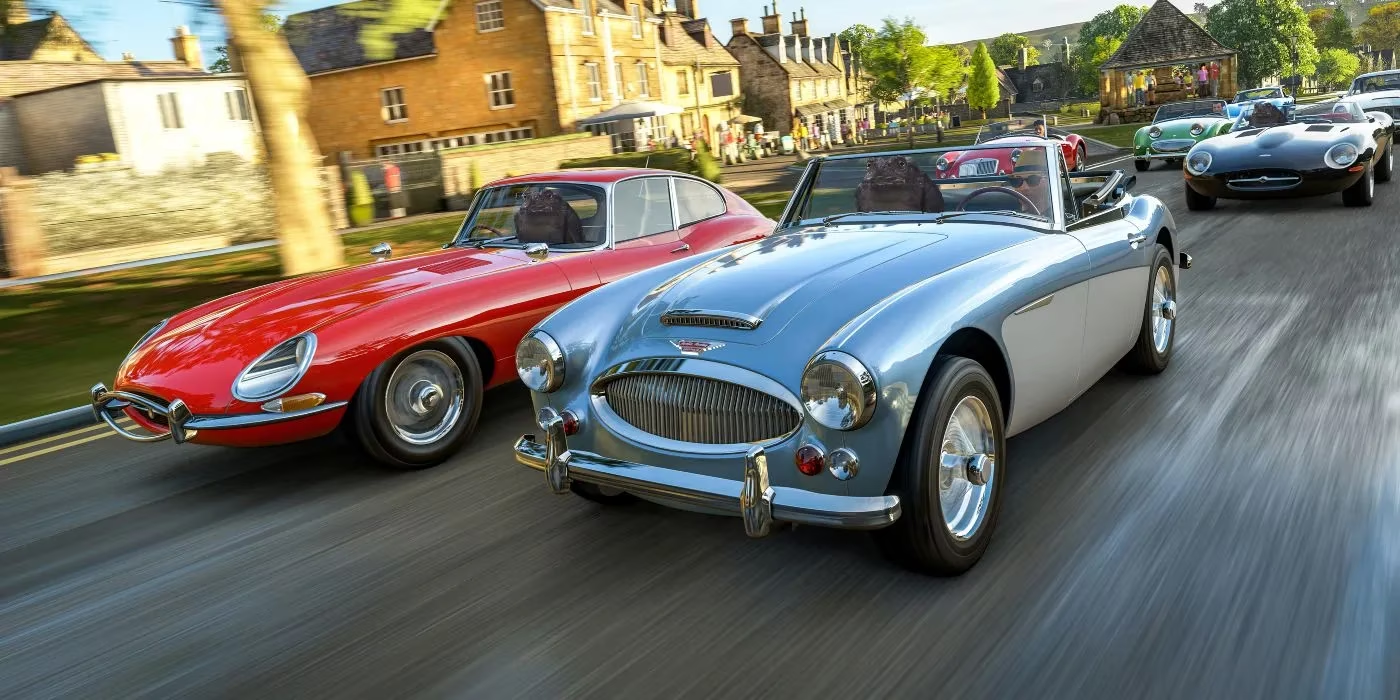
Booty's praise was not rooted in genre experience—Playground had literally only shipped Forza titles up to that point—but in an almost painterly attention to environmental storytelling. "I just look at what Playground has done with the Horizon series—that attention to detail, the ability to represent these naturalistic landscapes," he told The Guardian. That observation acted as a prism through which the studio's talent could be refracted onto Albion's mythic countryside. Where Lionhead's original Fable often framed its world through a storybook lens, Playground brought a different kind of fidelity: forests whose leaves shift under a passing storm, cobblestone streets that glisten after rainfall, distant mountain ranges that beckon like unfinished sentences. The studio's command of lighting and weather systems, honed across multiple Horizon installments, became a foundation for Fable's reimagined realm.
From Racing Circuits to Fairy Tales
The initial skepticism surrounding Playground's appointment was understandable. Fable's legacy rested on a flexible morality system that altered a hero's appearance, combat flourishes, and reactions from villagers. Its charm lay in British wit, fart jokes, and a world that remembered every small kindness or cruelty. Transferring that delicate alchemy to a team known for automotive polish felt like asking a master watchmaker to compose a symphony. But Booty framed the inexperience as a feature rather than a flaw, arguing that Playground's fresh eyes would prevent the project from becoming a museum piece. He noted a "real passion for the IP" alongside the technical pedigree, hinting that the studio understood the difference between respecting a franchise and embalming it.
The 2020 teaser trailer reinforced this argument without showing a single frame of gameplay. Its environments were not mere backdrops but characters in their own right—moss-covered ruins, enchanted woods, and a palpable sense of age. Such imagery validated Booty's belief that Playground could render "naturalistic landscapes" with an almost Romantic painter's devotion. It also suggested that the studio viewed Albion less as a level to be navigated and more as a living diorama whose geography influenced quests, secrets, and discovery.
A Balancing Act Between Legacy and Reinvention
Booty described the challenge of reviving Fable as walking a tightrope between "stuff that everyone wants you to bring along" and taking those elements to "new places." This sentiment became the guiding tension for a reboot announced into a gaming landscape vastly different from the one that last saw a numbered Fable entry in 2010. Players in 2020 craved open-world depth, meaningful choices, and seamless exploration—expectations shaped by The Witcher 3, Breath of the Wild, and Elden Ring. To ignore those conventions would be to court irrelevance; to abandon Fable's comedic soul would be betrayal.
Playground's solution, visible only after years of development, was to thread a needle between nostalgic echoes and bold invention. The studio preserved the series' signature blend of high-fantasy adventure and tongue-in-cheek humor. Morality returned, though it evolved beyond a simple binary into a web of reputations, grudges, and small consequences that rippled across hamlets and cities. Combat shed the floaty melee of earlier games for a weightier, animation-driven flow reminiscent of contemporary action RPGs, yet retained the flourish and flair that made Fable's heroes feel like dashing rogues rather than grim soldiers. The result was not a slavish remake but a resurrection that felt both familiar and disorientingly new—like hearing an old folk song performed with modern orchestration.
Hindsight in 2026
Now, in 2026, the question of whether Playground Games was the right steward for Fable has largely been answered. The game's launch on Xbox Series X|S and PC demonstrated that Booty's early optimism was not corporate spin. Reviews praised the dense, reactive world and the way side quests embedded themselves into the protagonist's reputation. Technical performance, an area where Playground's Forza expertise translated directly, proved exceptionally stable for a massive open-world title. The studio's handling of seasonal cycles—each season altering not just the environment but available activities and character interactions—showed the same meticulous iteration found in Horizon's dynamic festivals.
That said, the transition was not seamless. Some veteran fans missed the unpolished edges of Lionhead's original, the way its janky charm made failures feel personal. Others wished the humor landed with sharper timing. Yet these critiques are the inevitable friction of reviving a dormant franchise. Playground succeeded in doing what Booty promised: honoring the core of Fable while steering it into unexplored territory. The studio proved that a racing developer could indeed breathe life into a fairy tale, provided it treated the source material not as a blueprint to be traced but as a landscape to be lovingly repainted with its own distinctive brushstrokes.
Looking back, that 2020 image of Playground Games as an unlikely candidate feels almost quaint. The studio's "unique point of view" turned out to be exactly what Fable needed—a perspective unburdened by nostalgia's gravity, yet respectful enough to keep the heart of Albion beating. In an industry often paralyzed by sequel fatigue and risk aversion, Playground's journey from gearboxes to goblins stands as a reminder that sometimes the most faithful adaptation comes from those who arrive with fresh maps and willing hands.
This discussion is informed by reporting from The Verge - Gaming, where industry coverage often frames big-budget reboots like Fable through the lens of studio identity shifts, platform strategy, and the technical expectations of modern open worlds. That kind of perspective complements the blog’s focus on Playground Games’ transition from precision-built racing sandboxes to a humor-forward action RPG, highlighting how factors like engine tooling, world simulation, and player-choice reactivity can become the real make-or-break tests when a legacy franchise is rebuilt for a new generation.
Loading comments...