
In the vibrant gaming landscape of 2025, Peter Molyneux's visionary ideas from over a decade ago still echo through the industry, particularly his ambitious work on Fable 3. Back in the early 2010s, during a memorable interview at South by Southwest, Molyneux captivated audiences with his dream of transforming games into profound emotional experiences. He envisioned a world where players didn't just play as heroes but lived through the weight of power and responsibility, a concept that resonated deeply then and continues to shape modern titles today. As we reflect on that era, it's clear that Molyneux was not just a game developer; he was a prophet pushing boundaries, often ahead of his time. His passion for elevating gaming beyond mere entertainment sparked debates and innovations that have only intensified in the current year. 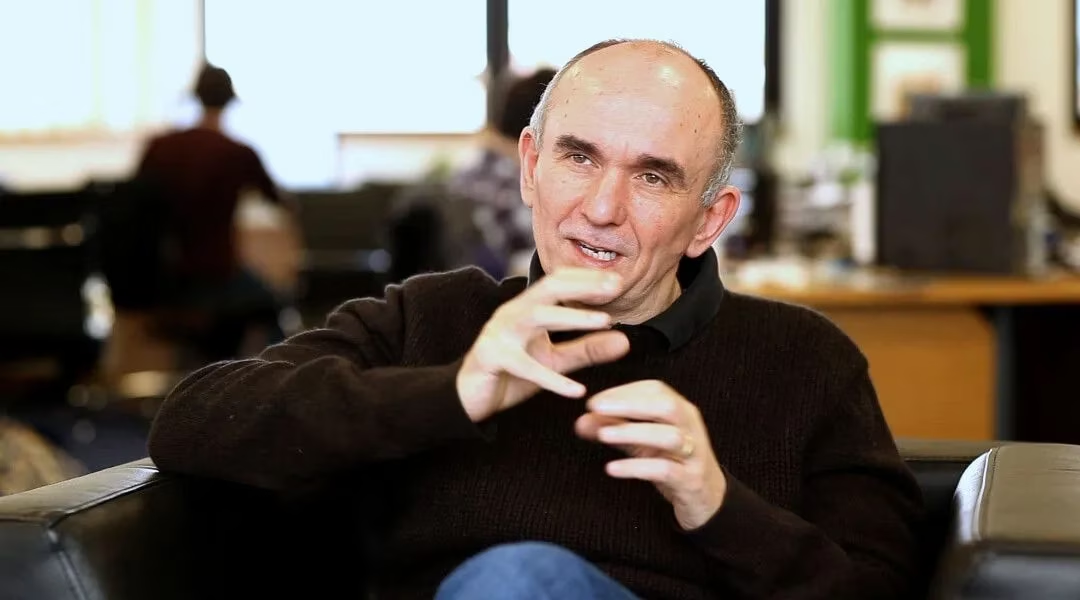
The Dual Journey of Fable 3: From Hero to Ruler
Molyneux's design for Fable 3 was revolutionary for its time, dividing the game into two distinct halves that mirrored the complexities of leadership. In the first part, players embarked on a quest to overthrow the tyrannical villain Logan, a battle that tested their courage and strategic prowess. This phase focused on building personal power, making players feel invincible as they rallied allies and overcame obstacles. Molyneux described it as an immersive journey to "make the player feel powerful," contrasting it with the mundane hero tropes common in other games. The second half shifted dramatically: after defeating Logan, the hero ascended to the throne, transforming the gameplay into a high-stakes simulation of rulership. Here, every decision—whether to raise taxes, declare war, or aid citizens—rippled through the kingdom, affecting not just the protagonist but the entire virtual world. This duality created a narrative depth that few titles had achieved, emphasizing themes of authority and consequence. 🤔 As Molyneux put it, "Fable 3 will have a lot of these new mechanics...and this feeling of power and responsibility which is really kind of interesting for a game like that and it has a relevance in today's world." In 2025, this approach has influenced countless games, from open-world epics to indie titles that simulate political dynamics, proving Molyneux's foresight in blending storytelling with player agency.
Key innovations in Fable 3's structure included:
-
Dynamic Kingdom Management: Players faced moral dilemmas that shaped their realm's prosperity or decline, a precursor to modern simulation games.
-
Emotional Weight of Choices: Decisions had lasting impacts, fostering a sense of ownership rarely seen before.
-
Narrative Flow: The seamless transition from action to strategy kept players engaged, avoiding the pitfalls of repetitive gameplay.
Revolutionary Mechanics: The Power of Emotional Touch
Beyond the narrative, Molyneux introduced the groundbreaking "touch" mechanic in Fable 3, aiming to evoke real emotional responses from players. He believed this feature could deepen the connection between gamers and their virtual worlds, making interactions feel more human and intimate. The mechanic allowed players to perform a range of actions, such as holding hands with allies to build trust, shaking hands to forge alliances, or hugging to express comfort. On the flip side, it included aggressive gestures like pushing or shoving, which could escalate conflicts or assert dominance. Molyneux described this as a tool to "affect gamers emotionally," envisioning it as a step toward games that could rival the emotional depth of films or books. 😊 However, its implementation was met with mixed reactions; while some players cherished the novelty, others found it awkward or underdeveloped. For instance, in Fable 2, the emotional bond with the dog companion often fell flat, but Molyneux hoped Fable 3's touch system would correct that, making rulership feel impactful—like the grief players felt over minor losses in Mass Effect 2. Fast forward to 2025, this mechanic has evolved into sophisticated AI-driven interactions in games, where haptic feedback and VR technologies enable nuanced physical connections, fulfilling Molyneux's dream of games that resonate on a personal level.
| Touch Action | Emotional Impact | Evolution in 2025 Games |
|---|---|---|
| Holding Hands | Builds trust and camaraderie | Used in VR narratives for therapeutic bonding, e.g., in mental health apps |
| Aggressive Shoving | Creates tension and conflict | Integrated into competitive esports for realistic player reactions |
| Hugging | Fosters comfort and loyalty | Enhanced by AI to adapt to player emotions in real-time |
Molyneux's Prophecy: Gaming Beyond the Ordinary
Molyneux's interview didn't stop at Fable 3; he shared bold predictions about the future of gaming, forecasting a shift that would redefine the medium itself. He asserted, "I really think that in the next two to three years, we're going to start seeing stuff from everybody and not just Microsoft, but from everyone, that just changes our whole thought on what a game is." He lamented that the word 'game' felt trivial compared to the emotional and narrative heights he envisioned. 😮 This foresight hinted at a world where games could convey complex feelings as effectively as literature or cinema, a vision that seemed lofty then but has materialized remarkably by 2025. For example, back in the day, titles like Final Fantasy 7 made players weep with Aeris's death, and Mass Effect 2 shocked audiences with Commander Shepard's dramatic intro, yet Molyneux pushed for more consistent emotional engagement. His ideas paved the way for today's innovations, such as neural-interface games that respond to brainwaves or AI-driven narratives that adapt to player moods. However, Molyneux was often criticized for thinking too far ahead—fans cared more about immediate gameplay than distant ideals. Still, his relentless drive to "move the game industry forward" inspired a generation of developers to explore uncharted territories, turning gaming into a respected art form.
The Enduring Legacy in 2025
Fifteen years after Fable 3's release, Molyneux's influence is undeniable in the modern gaming ecosystem. Games now routinely incorporate elements of power dynamics and emotional responsibility, from AAA franchises to indie hits, reflecting his core philosophy. Players in 2025 experience titles where decisions have global consequences, much like ruling Albion in Fable 3, but with enhanced realism thanks to cloud computing and AI. The touch mechanic, once a novelty, has blossomed into immersive features in VR and AR games, allowing for deeper social interactions that Molyneux dreamed of. 🎮 Reflecting on his journey, it's poignant to note how his predictions came true: major studios and indie creators alike have blurred the lines between games and interactive stories, with platforms offering experiences that educate, heal, and connect. Yet, Molyneux's legacy isn't without irony—while his ideas were revolutionary, they sometimes outpaced player expectations, as seen in Fable 2's emotional gaps. Today, games like those in the Mass Effect series continue to evoke strong feelings, but Molyneux's Fable 3 remains a cornerstone, reminding us that true innovation requires daring to envision the impossible. As we play in 2025, we honor his vision by embracing games that aren't just diversions but profound journeys of the heart and mind.
Loading comments...