
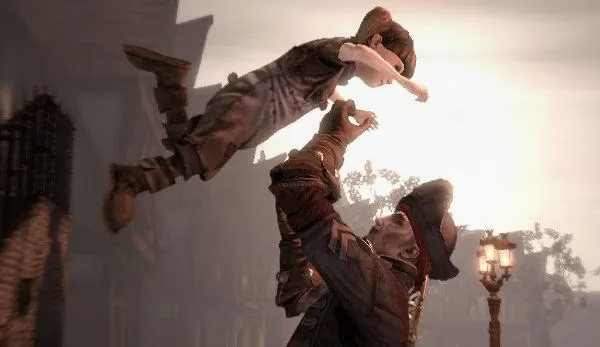
Looking back fifteen years later, Peter Molyneux's bold declarations about Fable 3's groundbreaking touch mechanics still resonate. I vividly recall the buzz at Microsoft's X10 event in 2010 when Molyneux himself warned these details might "piss people off." The core innovation wasn't about touchscreens or motion controls like Project Natal (though Natal support was planned), but something far more intimate: your character physically reaching out, touching NPCs within the game world, and triggering complex, human-like reactions. This wasn't just animation; it was an attempt to simulate the profound, intrinsic human need for connection through tactile interaction. Molyneux aimed to tap into that fundamental aspect of our nature, where a simple touch can alter moods, build trust, or sow discord, promising a level of emotional immersion rarely seen in RPGs.
The Power of Virtual Touch: Beyond Buttons
Lionhead Studios envisioned a system where touch wasn't a gimmick, but a core gameplay and narrative language:
-
Meaningful Interactions: Grabbing an NPC's hand wasn't just a canned animation; it was a deliberate action meant to convey comfort, urgency, dominance, or affection. The NPCs were designed to react authentically based on context, relationship status, and personality – much like a real person would flinch, relax, or pull away.
-
Emotional Resonance: The goal was to leverage proven real-world psychology. We know touch boosts oxytocin, reduces stress, and builds bonds. Molyneux wanted to translate that into the digital realm, making players feel the consequences of their virtual touch, fostering genuine attachment or conflict.
-
Shaping the World: This mechanic wasn't isolated. It tied directly into Fable 3's core theme of ruling and consequence. How you touched your subjects – with compassion or tyranny – would visibly shape your character's appearance, the kingdom's morale, and the unfolding narrative, truly embodying the Colin Wilson quote about the mind and hands changing the world.
Echoes of Ico: A Legacy of Connection
The ambition immediately reminded me, and many others, of the profound, wordless connection in Ico. That PS2 masterpiece achieved incredible emotional depth through simple mechanics:
- Yorda and Ico's Bond: The constant act of holding Yorda's hand, guiding her, pulling her to safety, wasn't just a puzzle solution; it was the heart of the game. That physical link created an unparalleled sense of responsibility and care in the player.
💡 Controlling Ico to protect Yorda forged a deep emotional transfer – their fear, determination, and connection became ours. It demonstrated the untapped potential of tactile interaction in games.
Molyneux aimed not just to replicate this magic but to expand it exponentially. Imagine Fable 3's touch system creating dozens of unique, meaningful bonds and reactions across an entire living world, not just between two characters. The potential for creating truly memorable, emotionally charged moments was staggering.
Molyneux's Grand Vision: Risk vs. Reward
Of course, Peter Molyneux was (and remains) famous for his monumental, often unrealized, ambitions. His history was a double-edged sword:
-
The Pattern: Promising revolutionary features for Fable and Fable 2 that were inevitably scaled back or altered significantly by launch. We learned to temper expectations.
-
Commendable Audacity: Despite the hype cycles, I always admired his refusal to play it safe. He pushed boundaries, dreamed of experiences far beyond the "cookie-cutter" RPGs, forcing the industry to consider bigger possibilities. Thinking about what could be was exhilarating.
-
The Gamble: The touch mechanic embodied this perfectly. It was a huge technical and design challenge. Could complex, context-sensitive human reactions to touch be simulated convincingly across countless NPC interactions? The risk of failure was high, but so was the potential reward – a game that could fundamentally alter how we connect with virtual characters and worlds.
🎮 Molyneux's mantra seemed to be: "Dream big, even if you stumble. The future of gaming is built on those risks." While Fable 3's final execution didn't fully meet the stratospheric hype, the attempt itself was significant.
The Enduring Legacy of an Emotional Experiment
Reflecting from 2025, Fable 3's touch system stands as a fascinating, ambitious experiment in emotional game design:
| Aspect | Ambition (2010) | Industry Impact (2025 Perspective) |
|---|---|---|
| NPC Reaction | Deeply contextual, human-like responses to touch | Paved the way for more advanced AI relationship systems |
| Player Bonding | Creating genuine attachment through physical interaction | Influenced narrative-driven games focusing on intimacy & connection |
| World Shaping | Touch directly altering kingdom & character | Reinforced the design link between player action & persistent consequence |
| Emotional Tech | Simulating the psychological impact of touch | Highlighted the challenge & value of non-verbal storytelling in games |
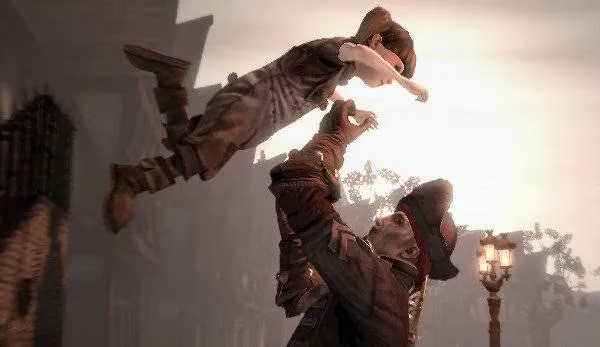
The concept of using virtual touch to manipulate player emotions remains complex and powerful. While Fable 3 didn't fully realize its most audacious promises, its core idea – that integrating such a fundamental human experience could lead to deeper immersion and more meaningful player agency – was visionary. It forced us to consider how games could simulate not just sight and sound, but the profound language of physical connection. Fifteen years on, we see echoes of that ambition in games striving for deeper emotional resonance, proving that even partially realized, Molyneux's gamble sparked conversations that continue to shape interactive storytelling. The dream of transferring that intrinsic part of our humanity into a game world, allowing us to shape it through touch, for better or worse, remains a compelling north star for the industry.
Loading comments...