
In the intricate, often chaotic world of game development, the most elegant solution isn't always the most complex one. Sometimes, it's a simple, bizarre, or downright wacky trick—a 'dev hack'—that holds everything together. These are the creative, last-minute fixes born from budget constraints, tool limitations, and the relentless pressure of deadlines. They are the digital duct tape and baling wire, the hidden scaffolding that players never see but that makes their adventures possible. The legendary 'load-bearing tomato,' a fictional concept from a viral post, perfectly captures this spirit: a single, seemingly random asset whose removal would cause the entire game to collapse. While that specific tomato may be a joke, the reality it represents is all too familiar to developers. Across decades and countless titles, these ingenious workarounds have saved projects, solved impossible bugs, and become cherished pieces of development folklore.
One of the earliest and most iconic examples comes from the original Assassin's Creed. Developer Charles Randall revealed that the one-armed assassin, Malik, presented a unique challenge. With no budget for a custom skeleton, the team devised a brilliantly simple solution: they turned his missing arm inside the model itself. Even more surreal was the revelation about the horses. Their internal skeletons were, in Randall's own words, just "twisted fucked up human skeletons." The development tools only worked with bipedal models, so animators and riggers had to contort a human skeleton into a horse-like shape—a testament to the artistry that can emerge from technical limitation.
The desire to avoid visual clipping—where one object unnaturally intersects another—has sparked countless hacks. In The Last of Us, when Ellie aims down the scope of her rifle, the weapon magically jumps out of her arms to float beside her. This isn't telekinesis; it's a clever trick to ensure the player's view through the scope is clear and unobstructed, avoiding the rifle model clipping through the camera. It’s a small, almost invisible adjustment that makes a huge difference to immersion.
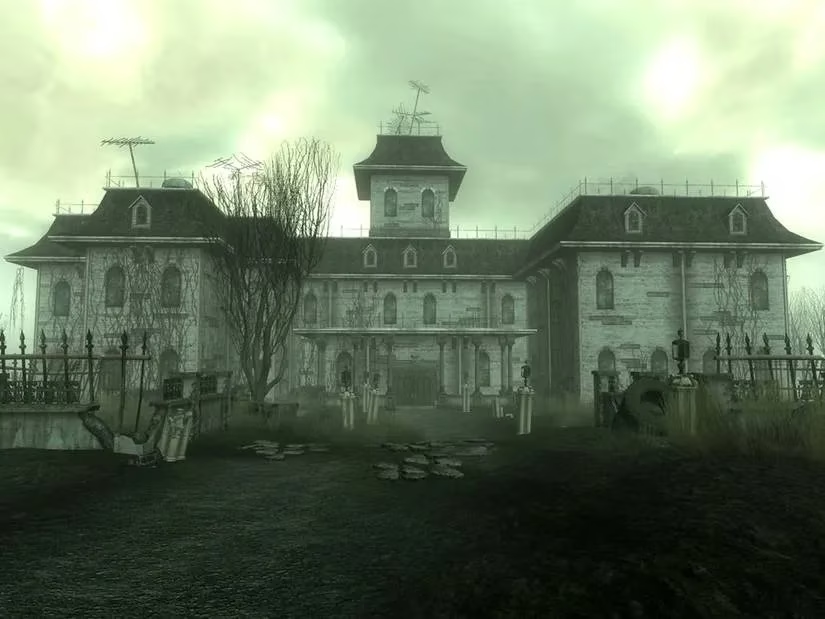
Sometimes, the hack isn't about hiding an asset but transforming its very purpose. In Fallout 3's Point Lookout DLC, artists Nate Purkeypile and Grant Struthers faced a problem. A key mansion was supposed to explode spectacularly, but as a distant, static asset, it couldn't be toggled on or off. Their solution was audacious: they made the mansion itself the explosion. By converting it into a dynamic asset, they could simply make it disappear, creating the illusion of a catastrophic blast. It was a bit finicky, but it achieved the desired dramatic impact with minimal system strain.
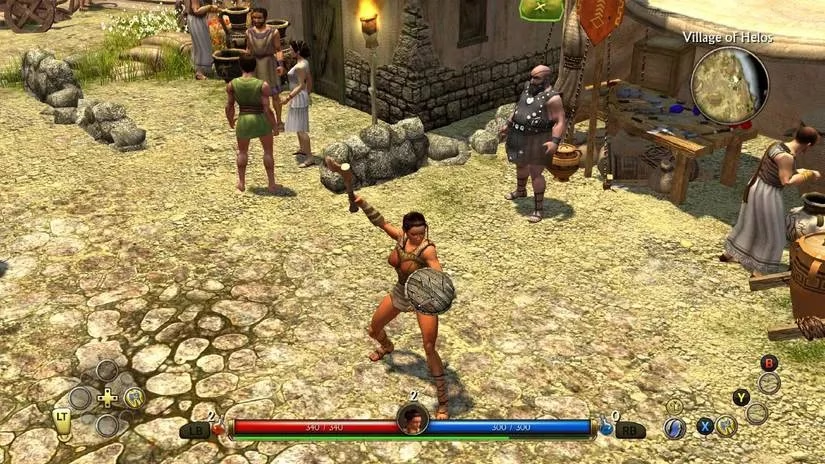
Quest scripting can be a nightmare, especially when the system lacks basic functions. During the development of Titan Quest, the event system had a critical flaw: it couldn't delay actions once they were triggered. Everything happened instantly. In the frantic pre-launch chaos, a QA tester stumbled upon a bizarre but effective workaround. The tester discovered that actions could be delayed based on the length of a character's idle animation. And so, the game's default timing system was born: invisible squirrels, scattered throughout the levels. Their idle animations became the hidden metronome that dictated the pacing of quests and events. This creative leap was so valued that the tester was promoted to a designer on the next project.
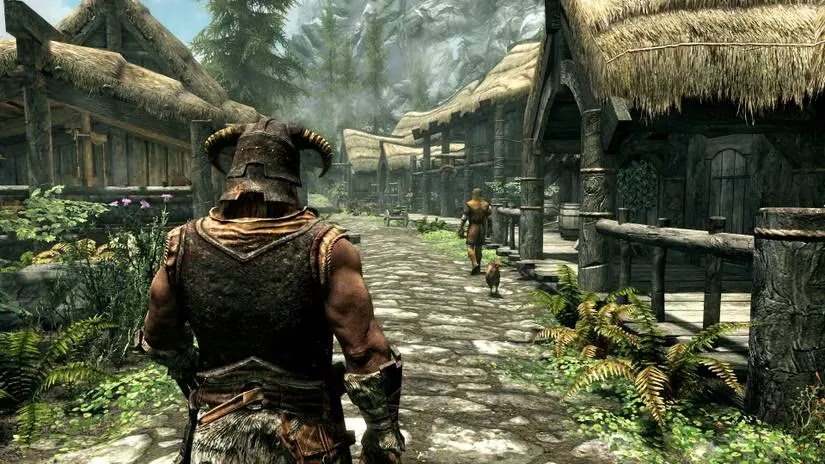
Managing the complex lives of NPCs is a monumental task. The Elder Scrolls V: Skyrim found an elegant, if exploitable, solution. To ease the burden on the game's systems for tracking every merchant's and citizen's inventory, developers gave nearly every NPC a hidden chest buried beneath the game world. These chests held all their belongings. While some were impossible to reach, others were just a bit of floor-clipping away, allowing thrifty (or cheaty) players to loot them directly instead of trading. It was a simple asset-reuse trick that saved immense computational overhead.
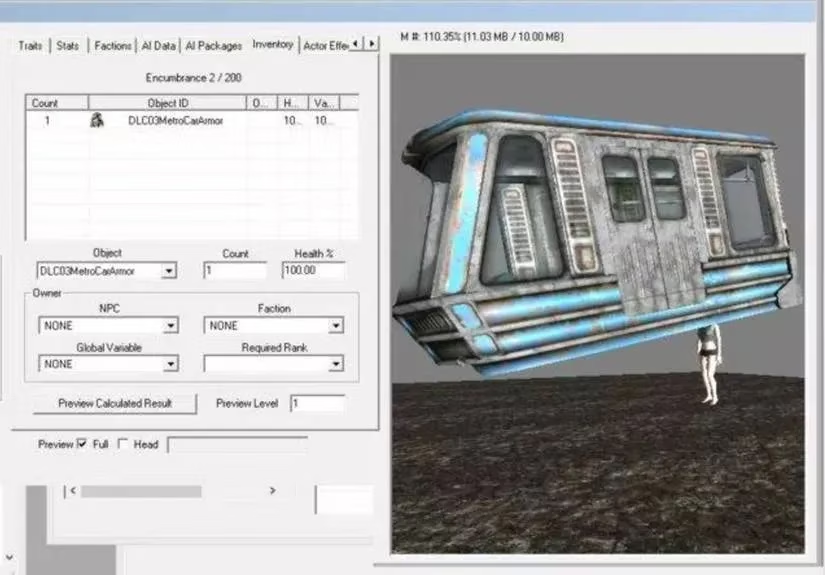
When a game lacks an entire system, developers have to get creative. Fallout 3's Broken Steel DLC needed a train ride, but the game had no vehicle mechanics. The solution? A train helmet. Upon boarding, the game equipped the player with a unique helmet item. This helmet changed the first-person camera view to that of a train interior and then animated the camera to move forward along a predetermined track. The player character never actually moved; the world simply slid by through a clever camera trick. It was a bug-free, cheap, and wonderfully silly way to simulate travel.

Not all hacks are complex. Often, the best solution is the simplest one. Facing a last-minute build issue in Fable: The Journey where textures were failing to load—leaving ugly grey voids in the environment—the team had no time for a deep fix. With the shipping deadline looming, Technical Designer Luke Parkes-Haskell and his colleagues chose the path of least resistance: they changed the default 'missing texture' material from grey to a pleasant grass green. Instantly, the glaring errors became subtle patches of turf. Problem solved.
Budget and time constraints often lead to cinematic shortcuts. In Obsidian's The Outer Worlds, the many video calls and broadcasts characters make were not pre-rendered cutscenes. Instead, the game would teleport the speaking character to a tiny, hidden diorama room outside the main level. They would stand in front of a static wallpaper image of their location, and the scene would be captured live in-engine. This hack eliminated the need for expensive, time-consuming cinematic production, a clever bit of theatrical staging that players never questioned.
Combat systems can have weird, hidden logic. In Star Wars: The Old Republic, principal combat designer Georg Zoeller faced a peculiar issue: the damage system was built to calculate hits between characters, not between characters and objects. So, how do you make an exploding barrel hurt a player? The answer was morbidly hilarious: each barrel was secretly filled with tiny, invisible NPCs. When the barrel exploded, the game registered it as these hidden 'people' attacking the player. An early version used complex models that tanked the frame rate, so they were swapped for ultra-simple ones. If it's stupid but it works, it isn't stupid.

Some hacks are so fundamental they change the hardware requirements. Donkey Kong 64 was famously the first Nintendo 64 game to require the Expansion Pak, boosting the console's RAM from 4MB to 8MB. The reason? A devastating, seemingly random crash that developers, including programmer Chris Marlow, could not solve through software alone. After exhaustive testing failed to find the root cause, they implemented the ultimate external hack: they mandated the more powerful hardware. By requiring the Expansion Pak, they effectively gave the game more memory to breathe, circumventing the elusive glitch. It was a hardware solution to a software problem, a bold move that ensured the game's stability.
From the Nintendo 64 era to the modern day, the spirit of the dev hack lives on. These stories are more than just amusing anecdotes; they are a celebration of pragmatic creativity under pressure. They remind us that the games we love are not flawless digital monuments but living, breathing projects built by humans who solve problems with whatever tools they have at hand. Whether it's an inside-out arm, an invisible squirrel, or a helmet that turns you into a train, these hacks are the hidden heart of game development—proof that sometimes, the most important thing in the game world is a single, load-bearing tomato.
Loading comments...