
In the digital tapestries woven by choice-based narratives, players don the mantle of fate, their every decision a brushstroke upon a canvas of consequence. While many seek the light, crafting tales of virtue and heroism, there exists a peculiar allure in the shadows—a fascination with the path less noble, where the heart of darkness beats in rhythm with the click of a button. To be the architect of despair, to taste the bitter fruit of malevolence, that is where some find their most profound, if unsettling, connection to these interactive worlds. It's a strange kind of fun, isn't it? Playing the villain, just to see what happens.
The Quiet Theft of Hope
In the gray, rain-soaked silence of a besieged city, This War of Mine asks not for grand heroics, but for simple survival. The game's soul whispers in the creaking floorboards of an old couple's home, a sanctuary amidst the ruins, brimming with the medicine and food that mean life itself. The husband's pleas are not threats, but the fragile sounds of a love facing extinction. "Please," he murmurs, a ghost in his own home, "do not take her medicine. She will not survive." To loot this place is to steal more than supplies; it is to extinguish two flickering lights. Returning later, the player finds only emptiness, a chilling testament to their calculus of survival. The game doesn't judge with fire and brimstone, but with the heavy, lingering sadness that settles over the player's own survivors—a quiet, internal damnation.
The Wish of a Hollow Crown
At the end of a grand adventure in Fable 2, the world holds its breath. A miraculous wish is granted, a chance to rewrite tragedy. The options gleam with potential: resurrect the slain masses, a act of divine mercy; or restore a lost family, love triumphing over death, a loyal dog included. And then, there is the third option. Cold, hard cash. Just a mountain of gold. Choosing wealth is the ultimate act of narrative vanity, a declaration that the entire epic journey was merely a transaction. The game rewards such villainy with a fitting aesthetic—horns and a demonic visage—but the true punishment is the hollow echo of that choice, the knowledge that countless souls remained ashes for the sake of a full coin purse. Talk about a bad deal.
Bonds Forged and Broken in Darkness
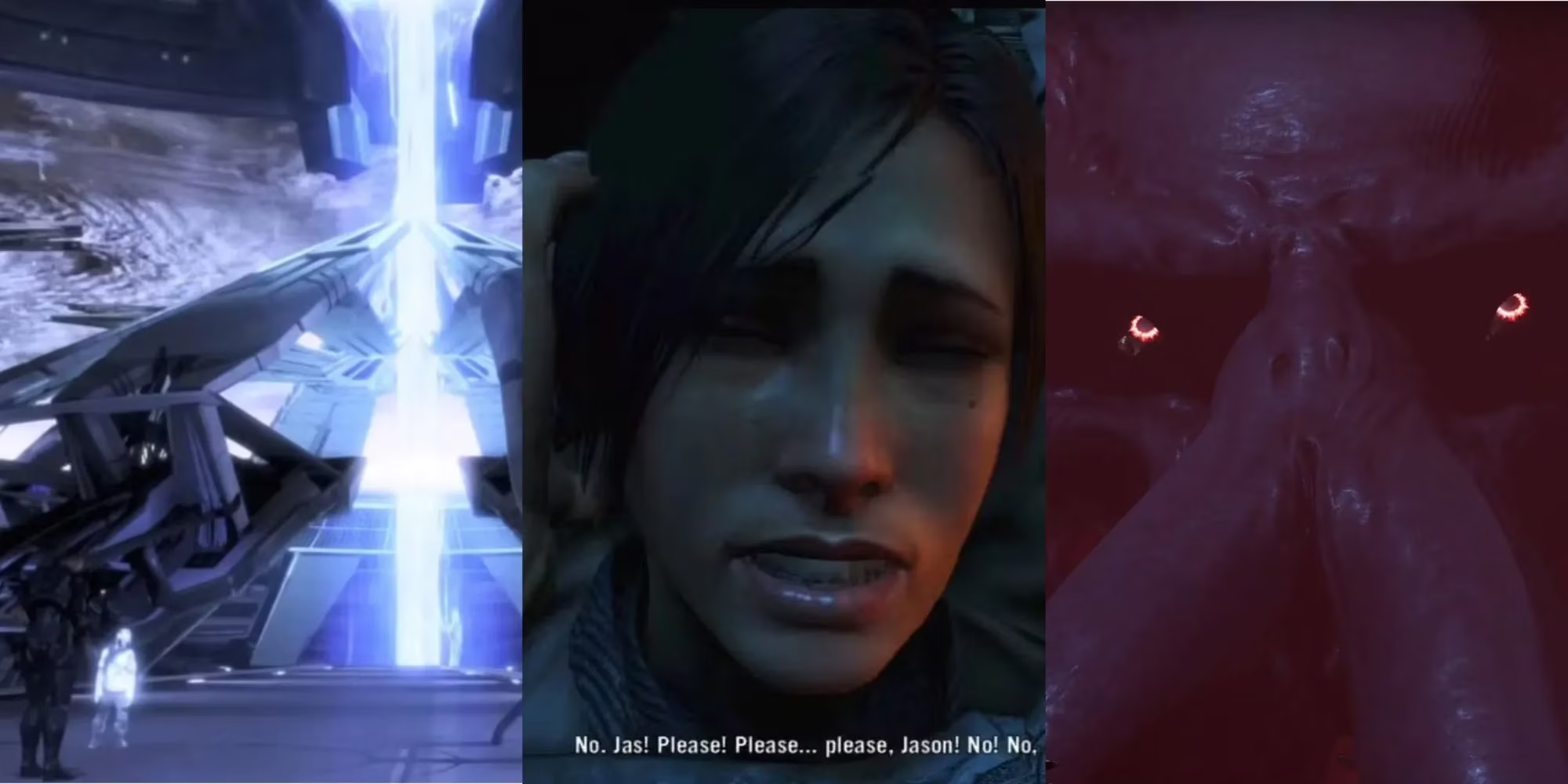
House of Ashes traps its characters in ancient subterranean terror, where American marine Jason and Iraqi soldier Salim begin as enemies. Through blood and fear, a brotherhood is forged, one of the narrative's most tender achievements. Salim speaks of his son, of birthday cakes and normalcy, a dream that keeps him fighting. Yet, in the climactic escape, the game offers Jason a terrible key: leave Salim behind. To sever that hard-won bond, to listen to the cries of a friend being dragged back into the vampiric dark while the elevator doors close, is a betrayal that resonates long after the controller is set down. It's the choice that says survival is a solitary affair, no matter the cost.
The Harvest of Innocence
The underwater dystopia of Rapture is built on a foundation of moral compromise, but BioShock 2 presents its dilemma with haunting clarity. The Little Sisters, innocent girls twisted by ADAM, wander the leaking halls. With each encounter, the player stands at a crossroads: rescue the child, or harvest her. The harvest is efficient, granting the precious ADAM needed to grow more powerful. It is a transaction of pure, unadulterated evil—trading a child's life for a stat boost. The game makes the temptation palpable, the power immediate, forcing the player to sit with the ghost of that choice every time they use an upgraded plasmid.
The Silence of the Doomed
Commander Shepard's saga in Mass Effect is defined by impossible choices, but the finale of Mass Effect 3 holds a unique kind of nihilistic wickedness. Faced with the galaxy's fate, the player can, in a moment of ultimate defiance or despair, simply... refuse to choose. In that silence, the Reapers win. Earth falls, Shepard's squad perishes, and all organic life is harvested. It is not an active evil, but a passive one of such colossal scale that it renders the hero's entire journey meaningless. It’s the ultimate "I quit" to the universe.
A Town Called Megaton
In the Capital Wasteland of Fallout 3, the settlement of Megaton thrives, ironically, around the dormant heart of its own destruction—an undetonated atomic bomb. For a player embracing infamy, the option is stark: accept a suite in Tenpenny Tower in exchange for pressing the button. The explosion is not a strategic necessity; it is spectacle as genocide. Watching the mushroom cloud rise, erasing a community and every named soul within it, is an act of cartoonish yet profoundly impactful villainy. It's evil for evil's sake, and the game's karma system brands you for it forever.
The Poisoned Embrace
Far Cry 3's journey transforms Jason Brody from victim to warrior, all in the name of rescuing his friends. The tribal leader Citra molds him, seduces him, and in the end, presents him with a twisted test of loyalty: kill your friends and stay with me. To choose Citra is to betray every relationship that motivated the harrowing campaign. The reward for this ultimate betrayal? After Jason murders his own brother and girlfriend, Citra herself ends his life in a ritual sacrifice. It is a cycle of betrayal that consumes the betrayer, a fittingly dark end for a path of pure selfishness.
The Abandonment of Alice
Detroit: Become Human weaves a tale of synthetic souls seeking humanity. Kara's story, as she protects the child Alice, is its emotional core. Their flight leads to a nightmarish recycling camp. In a moment of sheer panic, Kara can find a way out—a truck ready to depart. But there is no time to fetch Alice. The choice is instant and brutal: escape to freedom, or return to almost certain doom with the child. Choosing to flee, to leave the little girl she called her daughter alone in that hellscape, is a betrayal that feels uniquely intimate and cruel. After all they've been through... to just leave her there.
Claiming the Absolute Throne
The sprawling epic of Baldur's Gate 3 offers myriad paths to darkness, but its zenith of villainy arrives at the literal end of the world. Beside trusted allies, the player stands before the weakened Elder Brain, the source of the Absolute's tyranny. The heroic path is clear: destroy it. The evil one is sublime: betray your companion, seize control of the Brain, and become the new Absolute. This isn't just winning as a villain; it's usurping the apocalypse itself, enslaving the very companions who fought beside you, and claiming godlike power. It is the ultimate power fantasy, painted in the blackest of inks.
The Life Debt
The classic Star Wars: Knights of the Old Republic teaches that the pull of the dark side is often felt through personal bonds. The Wookiee Zaalbar swears a life debt to the player, a sacred oath. His best friend, Mission Vao, is like a sister to him. If the player fully embraces the Sith path, Mission may finally rebel. Here, the game offers one of gaming's most chilling commands: order Zaalbar to kill her. The scene unfolds with Mission begging, Zaalbar roaring in anguish, but compelled by his honor to obey. It is a choice that perverts loyalty into a weapon, destroying two hearts with a single, whispered command.
| Game | The Evil Choice | The Emotional Core |
|---|---|---|
| This War of Mine | Looting the elderly couple's medicine | The quiet death of compassion |
| Fable 2 | Wishing for wealth over love or lives | The hollow victory of greed |
| House of Ashes | Abandoning Salim | Betraying brotherhood for self |
| BioShock 2 | Harvesting a Little Sister | Trading a child's soul for power |
| Mass Effect 3 | Refusing to make a choice | Passive annihilation |
| Fallout 3 | Detonating the Megaton bomb | Annihilation as a transaction |
| Far Cry 3 | Killing friends for Citra | Being consumed by your own betrayal |
| Detroit: Become Human | Abandoning Alice at the camp | Choosing self-preservation over love |
| Baldur's Gate 3 | Seizing control of the Elder Brain | Becoming the god of tyranny |
| KOTOR | Forcing Zaalbar to kill Mission | Corrupting sacred loyalty into murder |
These moments linger because they are more than mechanics; they are reflections. They hold up a dark mirror, asking not "can you win?" but "who are you, when the only limit is the code itself?" The resonance of these wicked choices is a testament to the power of the medium—to make us feel the weight of a decision, even when it is woven from pixels and pretend. In these virtual moral wastelands, we sometimes walk the evil path not to escape ourselves, but to meet a part of ourselves we seldom acknowledge, if only to then turn back towards the light, wiser for the journey through the dark.
Loading comments...